 Stars4Water
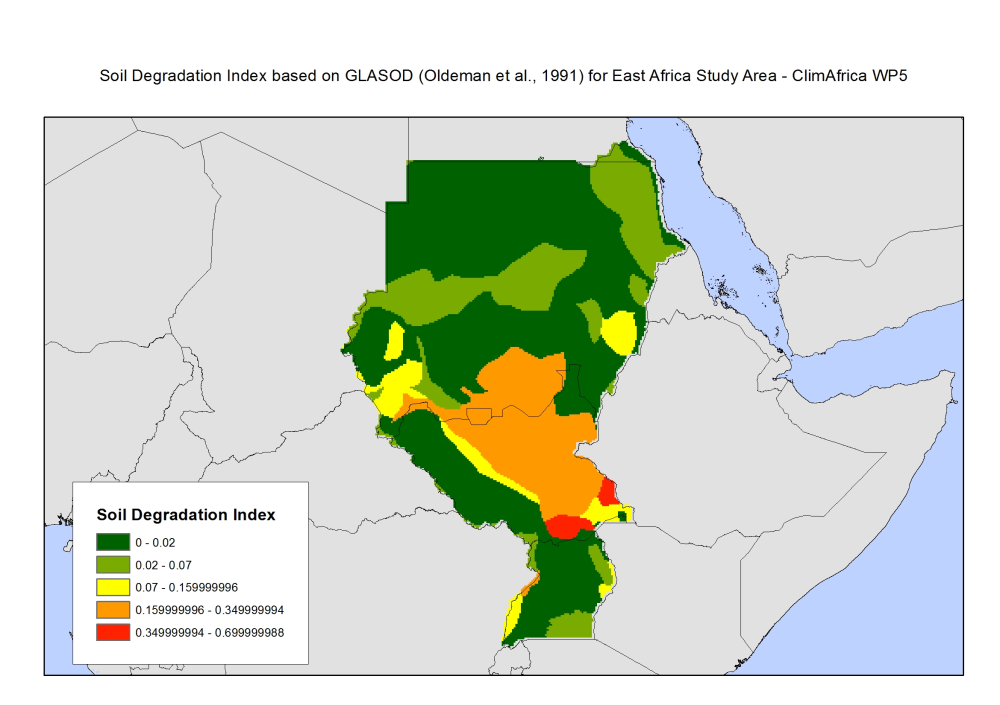
Soil degradation index in East Africa - ClimAfrica WP5
The soil degradation index is based on the Global Assessment of Human-induced Soil Degradation (GLASOD) (Oldeman et al., 1991). The UNEP-funded GLASOD project produced a world map of human-induced soil degradation. Data were compiled in cooperation with a large number of soil scientists throughout the world, using uniform guidelines and international correlation. The status of soil degradation was mapped within physiographic units, based on expert judgments, indicating the type, extent, degree, rate and main causes of the degradation process. To compare the impact of land degradation between different sites we created a land degradation index that attributes the following weights to area shares of the soil degradation classes 'light'= 1, 'moderate'=2, 'severeâ' = 3 and 'very severe' = 4. Next, we scaled the index between a range of 0-1. Combining classes and area shares in a single land degradation index is common practice in many other peer reviewed studies (e.g. Leiwen et al., 2005; McCoubrey, 1998; Pace at al., 2008; Safriel, 1999; Sonneveld and Dent, 2009), which gives us, sufficient confidence to apply the index for our analysis.
This dataset has been used to complement the survey data and included in the "Climate change predictions in Sub-Saharan Africa: impacts and adaptations (ClimAfrica)" project, Work Package 5 (WP5). More information on ClimAfrica project is provided in the Supplemental Information section of this metadata.
This study in WP5 aimed to identify, locate and characterize groups that are vulnerable for climate change conditions in two country clusters; one in West Africa (Benin, Burkina Faso, Côte d'Ivoire, Ghana, and Togo) and one in East Africa (Sudan, South Sudan and Uganda). Data used for the study include the Demographic and Health Surveys (DHS) , the Multi Indicator Cluster Survey (MICS) and the Afrobarometer surveys for the socio-economic variables and grid level data on agro-ecological and climatic conditions.
Simple
- Date (Creation)
- 2013-08-01T22:00:00
- Edition
-
First
- Presentation form
- Digital map
- Purpose
-
WP5 deals with economic assessment of agriculture and water sector based on a Computable General Equilibrium analysis (ICES) to produce the "inaction" and the adaptation scenarios, for direct climate change impacts on agricultural activity and on the direct cost and effectiveness of adaptation strategies. The main advantage of this investigation approach is to depict the economy as a system where goods and factor markets interacts domestically and internationally. Price effects, competitiveness effects, and demand & supply adjustments triggered by impacts on the agricultural sector can thus be properly captured. Moreover, the spatially explicit and dynamic economic modeling of vulnerability will have to accommodate bio-physical vulnerabilities.
- Status
- Completed
- Maintenance and update frequency
- As needed
- Theme
-
-
degradation index
-
soil degradation
-
land degradation
-
GLASOD
-
WP5
-
ClimAfrica
-
Tag_climafrica
-
- Place
-
-
Africa
-
Sudan
-
South Sudan
-
Uganda
-
- Access constraints
- Copyright
- Spatial representation type
- Grid
- Distance
- 10 Km
- Metadata language
- English
- Character set
- UTF8
- Topic category
-
- Geoscientific information
))
- Supplemental Information
-
ClimAfrica was an international project funded by European Commission under the 7th Framework Programme (FP7) for the period 2010-2014. The ClimAfrica consortium was formed by 18 institutions, 9 from Europe, 8 from Africa, and the Food and Agriculture Organization of United Nations (FAO).
ClimAfrica was conceived to respond to the urgent international need for the most appropriate and up-to-date tools and methodologies to better understand and predict climate change, assess its impact on African ecosystems and population, and develop the correct adaptation strategies. Africa is probably the most vulnerable continent to climate change and climate variability and shows diverse range of agro-ecological and geographical features. Thus the impacts of climate change can be very high and can greatly differ across the continent, and even within countries.
The project focused on the following specific objectives:
1. Develop improved climate predictions on seasonal to decadal climatic scales, especially relevant to SSA;
2. Assess climate impacts in key sectors of SSA livelihood and economy, especially water resources and agriculture;
3. Evaluate the vulnerability of ecosystems and civil population to inter-annual variations and longer trends (10 years) in climate;
4. Suggest and analyse new suited adaptation strategies, focused on local needs;
5. Develop a new concept of 10 years monitoring and forecasting warning system, useful for food security, risk management and civil protection in SSA;
6. Analyse the economic impacts of climate change on agriculture and water resources in SSA and the cost-effectiveness of potential adaptation measures.
The work of ClimAfrica project was broken down into the following work packages (WPs) closely connected. All the activities described in WP1, WP2, WP3, WP4, WP5 consider the domain of the entire South Sahara Africa region. Only WP6 has a country specific (watershed) spatial scale where models validation and detailed processes analysis are carried out.
- Reference system identifier
- WGS 1984
- Distribution format
-
-
ASCII format
(
)
-
ASCII format
(
)
- OnLine resource
-
DEGE.zip
(
WWW:DOWNLOAD-1.0-http--download
)
Degradation index in East Africa
- OnLine resource
-
D_5.2.1.pdf
(
WWW:DOWNLOAD-1.0-http--download
)
A spatially explicit assessment of specific vulnerabilities of the food system due to climate change and the identification of their causes; Technical report
- OnLine resource
- Scenarios of major production systems in Africa ( WWW:LINK-1.0-http--link )
- OnLine resource
- CLIMAFRICA – Climate change predictions in Sub-Saharan Africa: impacts and adaptations ( WWW:LINK-1.0-http--link )
- File identifier
- 1f783616-c7a0-49a9-8a6f-8656d79b4583 XML
- Metadata language
- English
- Character set
- UTF8
- Date stamp
- 2023-01-31T10:46:52
- Metadata standard name
-
ISO 19115:2003/19139
- Metadata standard version
-
1.0
Overviews
Spatial extent
Provided by
