SSP Database (Shared Socioeconomic Pathways) - Version 2.0
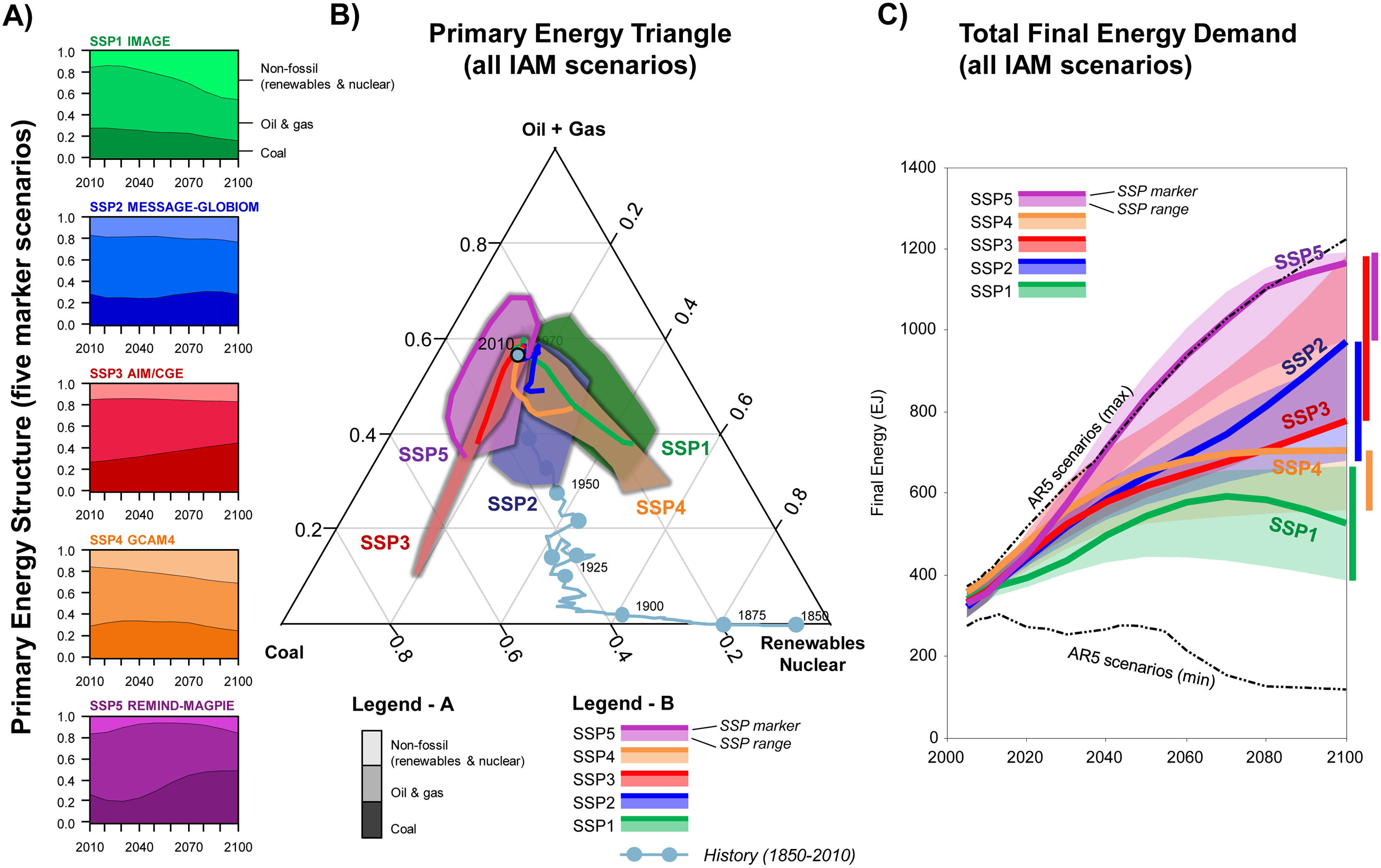
This paper and dataset presents the overview of the Shared Socioeconomic Pathways (SSPs) and their energy, land use, and emissions implications. The SSPs are part of a new scenario framework, established by the climate change research community in order to facilitate the integrated analysis of future climate impacts, vulnerabilities, adaptation, and mitigation. The pathways were developed over the last years as a joint community effort and describe plausible major global developments that together would lead in the future to different challenges for mitigation and adaptation to climate change. The SSPs are based on five narratives describing alternative socio-economic developments, including sustainable development, regional rivalry, inequality, fossil-fueled development, and middle-of-the-road development. The long-term demographic and economic projections of the SSPs depict a wide uncertainty range consistent with the scenario literature. A multi-model approach was used for the elaboration of the energy, land-use and the emissions trajectories of SSP-based scenarios. The baseline scenarios lead to global energy consumption of 400–1200 EJ in 2100, and feature vastly different land-use dynamics, ranging from a possible reduction in cropland area up to a massive expansion by more than 700 million hectares by 2100. The associated annual CO2 emissions of the baseline scenarios range from about 25 GtCO2 to more than 120 GtCO2 per year by 2100. With respect to mitigation, we find that associated costs strongly depend on three factors: (1) the policy assumptions, (2) the socio-economic narrative, and (3) the stringency of the target. The carbon price for reaching the target of 2.6 W/m2 that is consistent with a temperature change limit of 2 °C, differs in our analysis thus by about a factor of three across the SSP marker scenarios. Moreover, many models could not reach this target from the SSPs with high mitigation challenges. While the SSPs were designed to represent different mitigation and adaptation challenges, the resulting narratives and quantifications span a wide range of different futures broadly representative of the current literature. This allows their subsequent use and development in new assessments and research projects. Critical next steps for the community scenario process will, among others, involve regional and sectoral extensions, further elaboration of the adaptation and impacts dimension, as well as employing the SSP scenarios with the new generation of earth system models as part of the 6th climate model intercomparison project (CMIP6).
Recommended article. The Shared Socioeconomic Pathways and their energy, land use, and greenhouse gas emissions implications: An overview, Global Environmental Change, Volume 42, Pages 153-168, 2017, ISSN 0959-3780, DOI:110.1016/j.gloenvcha.2016.05.009.
Simple
- Date (Publication)
- 2018-01-01
- Status
- Historical archive
- Maintenance and update frequency
- Not planned
- Theme
-
-
Shared Socioeconomic Pathways
-
Climate change
-
SSP
-
RCP
-
Community scenarios
-
Mitigation
-
Adaptation
-
socioeconomic
-
water availability
-
- Place
-
-
World
-
- Access constraints
- Other restrictions
- Use constraints
- Other restrictions
- Other constraints
-
The content of the SSP database and any derived analysis may only be used for non-commercial scientific publications, articles, educational purposes, figures and data tables provided that the source reference pursuant to section ‘Required citation’ is included and all relevant publications are correctly cited. Partial reproductions of the database content may be stored in online repositories, if this is necessary to comply with a journal?s data archiving and access requirements. Such reproductions must be limited to the scope of the manuscript in question, and must include a hyperlink to the source database hosted at https://tntcat.iiasa.ac.at/SspDb and the download date from the source database.
However, any wholesale duplication, translation, reworking, processing, arrangement, transformation, or reproduction through the internet or any other channels, of the https://tntcat.iiasa.ac.at/SspDb for commercial or non-commercial purposes is not permitted without the explicit written approval of IIASA. See further https://tntcat.iiasa.ac.at/SspDb/dsd?Action=htmlpage&page=10
- Spatial representation type
- Text, table
- Metadata language
-
eng
- Character set
- UTF8
- Topic category
-
- Boundaries
- Begin date
- 2020-01-01
- End date
- 2100-01-01
))
- Reference system identifier
- WGS 1984
- Number of dimensions
- 3
- Dimension name
- Row
- Dimension name
- Column
- Dimension name
- Vertical
- Cell geometry
- Area
- OnLine resource
-
IIASA
(
WWW:LINK-1.0-http--link
)
International Institute for Applied Systems Analysis (IIASA)
We are an international research institute that advances systems analysis and applies its research methods to identify policy solutions to reduce human footprints, enhance the resilience of natural and socioeconomic systems, and help achieve the sustainable development goals.
- OnLine resource
-
SSP Database (Shared Socioeconomic Pathways) - Version 2.0
(
WWW:LINK-1.0-http--link
)
SSP Public Database
- Hierarchy level
- Dataset
- File identifier
- 5797366b-0c80-4c54-8fb8-bb8db493af85 XML
- Metadata language
- English
- Character set
- UTF8
- Date stamp
- 2023-08-18T11:50:26
- Metadata standard name
-
ISO 19115:2003/19139
- Metadata standard version
-
1.0
Overviews
Spatial extent
Provided by