 Stars4Water
sensitivity
Type of resources
Available actions
Topics
Keywords
Contact for the resource
Provided by
Years
Representation types
Update frequencies
status
Resolution
-

The “malnourishment index” relates to the degree of food insecurity of a certain region in 2010. A community characterized by scarce food quality supply and thus subject to malnutrition and starvation of large part of its members is prone to suffer from climate change impact on food production. The index results from the second cluster of the Principal Component Analysis preformed among 14 potential variables. The analysis identify four dominant variables, namely “percentage of underweighted children”, “percentage of stunted children”, “diet diversification index” and “animal protein supply”, assigning a weight of 0.25 to the “percentage of underweighted children” and the “percentage of stunted children”, 0.3 to the “animal protein supply” and 0.2 to the “diet diversification index”. Before to perform the analysis the variables were score-standardized (converted to distribution with average of 0 and standard deviation of 1; “diet diversification index” and “animal protein supply” with inverse method) in order to be comparable. The first administrative level data for “percentage of underweighted children” (more than two standard deviations below the mean weight-for-age score of the NCHS/CDC/WHO international reference population) and “percentage of stunted children” (more than two standard deviations below the mean height-for-age score of the NCHS/CDC/WHO international reference population) were derived from the Global Database on Child Growth and Malnutrition of WHO/UNICEF (data range from 1998 to 2012). When subnational data were not available, were used the national values from UNICEF database. Such national figures were used also to normalize to 2010 the values recorded by WHO/UNICEF. Tabular data were linked by first administrative unit to the first administrative boundaries shapefile (FAO/GAUL) and then converted into raster format (resolution 0.5 arc-minute). The country based values for the other two variables were collected from FAO statistics like the average of the period 2008-2012. Tabular data were linked by country to the national boundaries shapefile (FAO/GAUL) and then converted into raster format (resolution 0.5 arc-minute). Malnourishment illustrates the problems of food insecurity and hunger of a population, which has serious consequences on people's physical condition and very negative impacts on the mental and physical development of children. Countries which have worst diet parameters are more sensitive to the effects of the climate change. Indeed low animal protein consumption and low diet diversification (dominated by cereals) are indicators of the lack of alternative food source than local cereals production. This dataset has been produced in the framework of the “Climate change predictions in Sub-Saharan Africa: impacts and adaptations (ClimAfrica)” project, Work Package 4 (WP4). More information on ClimAfrica project is provided in the Supplemental Information section of this metadata.
-
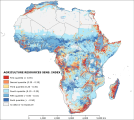
The “agriculture resources sensitivity” represents the agriculture potential in 2010. This potential is measured by the availability of land and food production per capita, and the main thread to agriculture land, represented by desertification risk. The index results from the second cluster of the Principal Component Analysis preformed among 16 potential variables. The analysis identify four dominant variables, namely “potential rain-fed food production per capita”, “cropland crowding”, “desertification index” and “topographic resources availability”, assigning respectively the weights of 0.29, 0.29, 0.27 and 0.15. Before to perform the analysis all the variables were log transformed to shorten the extreme variation and then were score-standardized (converted to distribution with average of 0 and standard deviation of 1; all variables with inverse method except “desertification index”) in order to be comparable. The 5 arc-minute grid “potential rain-fed food production per capita” of 2007 was gathered from FAO GeoNetwork and then sampled at 0.5 arc-minutes. It was multiplied by crop land occurrence dataset, extracted from the FAO Global Land Cover-SHARE dataset of 2014 and divided by population grid in order to compute the per capita values. The 0.5 arc-minute grid “cropland crowding” of 2010 was produced dividing the crop land occurrence (FAO Global Land Cover-SHARE) by the population. The 0.5 arc-minute grid “desertification index” of 2000 was measured in terms of number of months recording values less than 0.75 of the ratio between precipitation (current monthly average) and potential evapo-transpiration (PET, current monthly average). Data of precipitation and PET were gathered from Worldclim and from CGIAR Consortium for Spatial Information, respectively. Finally the 0.5 arc-minute grid “topographic resources availability” was produced within the ClimAfrica project based on SRTM DEM of NASA. The “potential rain-fed food production per capita” measures the availability of food in a certain area produced with subsistence techniques. Cells with low food production are sensitive to climate change impacts because the low input agriculture (dominant in Africa) may not produced sufficient food quantities to support the local populations. The “cropland crowding” is an indicator that assess the availability of crop land hectares per 1,000 people. Sensitive areas are where few crop lands are shared by large population. The “desertification index” assesses the climatological risk of a certain area to be subjected to desertification due to lack of rainfall. Such areas are more sensitive to lost crop land and thus food production quantities due to climate change impacts. The “topographic resources availability” is the percentage of each cell with slopes equal to or lower than 15 %. Landscapes strongly dissected contain less land with agriculture values than plain landscapes. The scarcity of agriculture land may increase the fragility of a system because unable to increase to crop surface to cope with climate change impacts. This dataset has been produced in the framework of the “Climate change predictions in Sub-Saharan Africa: impacts and adaptations (ClimAfrica)” project, Work Package 4 (WP4). More information on ClimAfrica project is provided in the Supplemental Information section of this metadata.
-
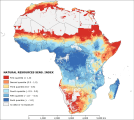
The “natural resources sensitivity” symbolizes the ecosystem vitality and degree of conservation in 2010. Deforestation and loss of water resources quality may render certain areas more sensitive to climate stressors on account of the loss of normal vegetation cover, the depletion of biodiversity, the reduction in ecosystem services and significant loss of beneficial assets. The index results from the first cluster of the Principal Component Analysis preformed among 16 potential variables. The analysis identify five dominant variables, namely “water availability per capita”, “net primary production”, “forest accessibility”, “vegetation continuity” and “climatic resources availability”, assigning respectively the weights of 0.19, 0.21, 0.165, 0.21 and 0.225. Before to perform the analysis the variables “water availability per capita”, “forest accessibility” and “vegetation continuity” were log transformed to shorten the extreme variation and then together with the other two variables were score-standardized (converted to distribution with average of 0 and standard deviation of 1; all variables with inverse method) in order to be comparable. The 6 arc-minute grid “water availability per capita” of 2005 was computed by sum of the run-off and discharge grids produced by World Water Development Report II and then sampled at 0.5 arc-minutes. A focal statistic ran with a radius of 55 cells (about 50 Km). This had a smoothing effect and represents some of the extend influence of major rivers as a resources for local people. To calculate the available water per capita it was then divided by the population. The 5 arc-minute grid “net primary production” of 2000 was gathered from FAO GeoNetwork and sampled at 0.5 arc-minute. Also in this case a focal statistic ran with a radius of 22 cells (about 20 Km) in order to represents the extend effect of primary production as natural resources for local people. The 0.5 arc-minute grid “forest accessibility” was build using the grid of travel distance in minutes to large cities (which one with population greater than 50,000 people), produced by the European Commission and the World Bank to represent the connectivity in 2000, and the grid of forest occurrence, extracted from the FAO Global Land Cover-SHARE dataset of 2014. The result measures the distance in minutes between forest and cities, thus is a proxy for remoteness and naturalness of forest. The 0.125 arc-minute grid “vegetation continuity” of 2010 were collected from University of Maryland and NASA and sampled at 0.5 arc-minute. A focal statistic ran with a radius of 55 cells (about 50 Km). This had a smoothing effect and represents some of the extend influence of vegetation concentration as a resources for local people. Finally the 0.5 arc-minute grid “climatic resources availability” was produced within the ClimAfrica project. The “water availability per capita” represents the potential water available per people in a certain area. We can consider the area with small values more sensitive to climatic stress, because lack a buffer of water resources, precious in a prevalently rain-fed agricultural system like in Africa. The “net primary production” and the “vegetation continuity” are proxies of the potential vegetal productivity available in a certain area. Moreover “vegetation continuity” is an indicator of abundance of natural ecosystem services that can reduce the sensitivity of human-environment systems. The “forest accessibility” assessing the distance between human and natural system measure the anthropogenic degree of a forest. A forest recording a high anthropogenic degree (thus near in terms of minute from a city) may potentially be threaded by human activity and thus represent a fragile ecosystem. Finally the “climatic resources availability” is an indicator of the climatic potential for biomass production. It is based on the climatically determined biomass productivity index that is a proxy for the atmospheric energy available for biomass production, as expressed by accumulated temperature, adjusted for drought stress. This dataset has been produced in the framework of the “Climate change predictions in Sub-Saharan Africa: impacts and adaptations (ClimAfrica)” project, Work Package 4 (WP4). More information on ClimAfrica project is provided in the Supplemental Information section of this metadata.