 Stars4Water
vegetation
Type of resources
Available actions
Topics
Keywords
Contact for the resource
Provided by
Representation types
Update frequencies
status
Scale
-
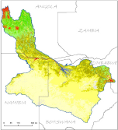
This raster layer represents the land cover classification within the Okavango Basin. Source: Generated under the GIS EPSMO program (Classification based on MODIS Vegetation Continues Fields data from 2000-2005). This dataset is part of the GIS Database for the Environment Protection and Sustainable Management of the Okavango River Basin project (EPSMO). Detailed information on the database can be found in the “GIS Database for the EPSMO Project†document produced by Luis Veríssimo (FAO consultant) in July 2009, and here available for download.
-

Vegetation classes according to White's (1983) classification within the Okavango Basin. Source: Vegetation Map of Africa, White 1983, UNESCO/AETFAT/UNSO. This dataset is part of the GIS Database for the Environment Protection and Sustainable Management of the Okavango River Basin project (EPSMO). Detailed information on the database can be found in the “GIS Database for the EPSMO Project†document produced by Luis Veríssimo (FAO consultant) in July 2009, and here available for download.
-
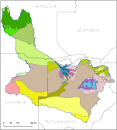
This vector layer delineates the phytogeographic units within the Okavango Basin. Source: Several (FAO, WCMC, Phytogeographic Chart of Angola). Irreconcilable adjustments between Namibia and Botswana. This dataset is part of the GIS Database for the Environment Protection and Sustainable Management of the Okavango River Basin project (EPSMO). Detailed information on the database can be found in the “GIS Database for the EPSMO Project†document produced by Luis Veríssimo (FAO consultant) in July 2009, and here available for download.
-
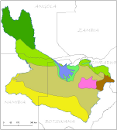
Distribution of Ecoregions within the Okavango Basin. Source: World Wild Life Fund (WWF). This dataset is part of the GIS Database for the Environment Protection and Sustainable Management of the Okavango River Basin project (EPSMO). Detailed information on the database can be found in the “GIS Database for the EPSMO Project†document produced by Luis Veríssimo (FAO consultant) in July 2009, and here available for download.