 Stars4Water
Asia
Type of resources
Available actions
Topics
Keywords
Contact for the resource
Provided by
Years
Formats
Representation types
Update frequencies
status
Resolution
-
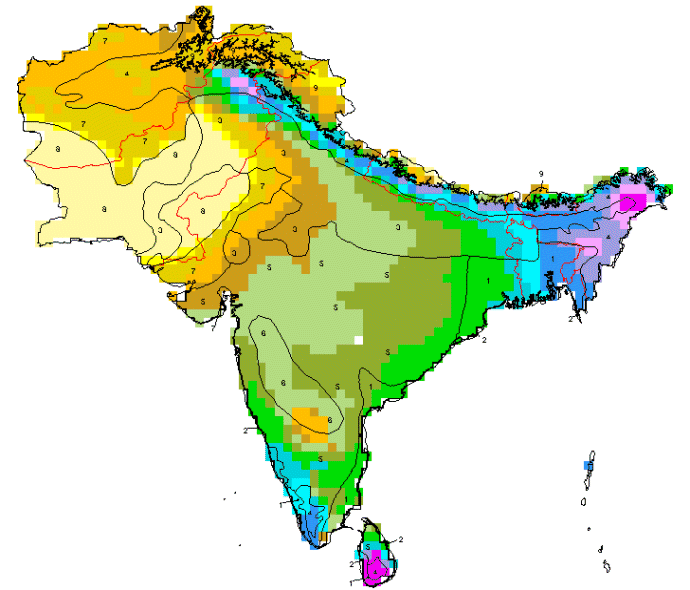
As part of the the World Bank's review of its rural development strategy, the Bank sought the assistance of the Food and Agriculture Organization of the United Nations (FAO) in evaluating how farming systems might change and adapt over the next thirty years. Amongst other objectives, the World Bank asked FAO to provide guidance on priorities for investment in food security, poverty reduction, and economic growth, and in particular to identify promising approaches and technologies that will contribute to these goals. The results of the study are summarized in a set of seven documents, comprising six regional reports and the global overview contained in this volume. This document, which synthesises the results of the six regional analyses as well as discussing global trends, cross-cutting issues and possible implementation modalities, presents an overview of the complete study. This document is supplemented by two case study reports of development issues of importance to farming systems globally.
-
As part of the the World Bank's review of its rural development strategy, the Bank sought the assistance of the Food and Agriculture Organization of the United Nations (FAO) in evaluating how farming systems might change and adapt over the next thirty years. Amongst other objectives, the World Bank asked FAO to provide guidance on priorities for investment in food security, poverty reduction, and economic growth, and in particular to identify promising approaches and technologies that will contribute to these goals. The results of the study are summarized in a set of seven documents, comprising six regional reports and the global overview contained in this volume. This document, which synthesises the results of the six regional analyses as well as discussing global trends, cross-cutting issues and possible implementation modalities, presents an overview of the complete study. This document is supplemented by two case study reports of development issues of importance to farming systems globally.
-
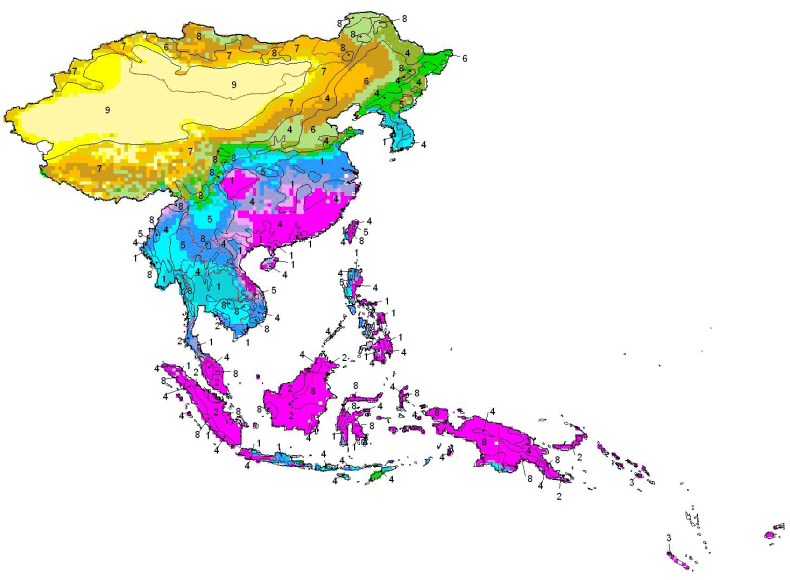
As part of the the World Bank's review of its rural development strategy, the Bank sought the assistance of the Food and Agriculture Organization of the United Nations (FAO) in evaluating how farming systems might change and adapt over the next thirty years. Amongst other objectives, the World Bank asked FAO to provide guidance on priorities for investment in food security, poverty reduction, and economic growth, and in particular to identify promising approaches and technologies that will contribute to these goals. The results of the study are summarized in a set of seven documents, comprising six regional reports and the global overview contained in this volume. This document, which synthesises the results of the six regional analyses as well as discussing global trends, cross-cutting issues and possible implementation modalities, presents an overview of the complete study. This document is supplemented by two case study reports of development issues of importance to farming systems globally.
-

As part of the the World Bank's review of its rural development strategy, the Bank sought the assistance of the Food and Agriculture Organization of the United Nations (FAO) in evaluating how farming systems might change and adapt over the next thirty years. Amongst other objectives, the World Bank asked FAO to provide guidance on priorities for investment in food security, poverty reduction, and economic growth, and in particular to identify promising approaches and technologies that will contribute to these goals. The results of the study are summarized in a set of seven documents, comprising six regional reports and the global overview contained in this volume. This document, which synthesises the results of the six regional analyses as well as discussing global trends, cross-cutting issues and possible implementation modalities, presents an overview of the complete study. This document is supplemented by two case study reports of development issues of importance to farming systems globally.
-

As part of the the World Bank's review of its rural development strategy, the Bank sought the assistance of the Food and Agriculture Organization of the United Nations (FAO) in evaluating how farming systems might change and adapt over the next thirty years. Amongst other objectives, the World Bank asked FAO to provide guidance on priorities for investment in food security, poverty reduction, and economic growth, and in particular to identify promising approaches and technologies that will contribute to these goals. The results of the study are summarized in a set of seven documents, comprising six regional reports and the global overview contained in this volume. This document, which synthesises the results of the six regional analyses as well as discussing global trends, cross-cutting issues and possible implementation modalities, presents an overview of the complete study. This document is supplemented by two case study reports of development issues of importance to farming systems globally.
-

The combination of yield gap and poverty rates into a single map enables to identify best feasible modalities for agricultural development, potential investment, and resource allocation. - Yield gap provides important information for identifying causes of food insecurity and addressing rural poverty. Yield and production gaps have been estimated by comparing at a spatially detailed level of 5 arc-minutes the agro-ecological attainable yield and production of 22 major crops/crop groups, simulated under the historical climate of 1981-2010, with actual yields and production obtained by downscaling for the years 2000 and 2010 statistical data of main food, feed, and fiber crops. - The poverty map portrays poverty rates at the country level. Poverty rates vary from 12.7 to 76.2 percent. Accordingly, the higher percentage of poverty in a particular area, the poorer population is located there.
-

The combination of yield gap and poverty rates into a single map enables to identify best feasible modalities for agricultural development, potential investment, and resource allocation. - Yield gap provides important information for identifying causes of food insecurity and addressing rural poverty. Yield and production gaps have been estimated by comparing at a spatially detailed level of 5 arc-minutes the agro-ecological attainable yield and production of 22 major crops/crop groups, simulated under the historical climate of 1981-2010, with actual yields and production obtained by downscaling for the years 2000 and 2010 statistical data of main food, feed, and fiber crops. - The poverty map portrays poverty rates at the country level. Accordingly, the higher percentage of poverty in a particular area, the poorer population is located there.
-

The 1km raster dataset represents top location score areas filtered by exclusive criteria: access to finance, distance to major roads and access to IT. The layer is produced under the scope of FAO’s Hand-in-Hand Initiative, Geographical Information Systems - Multicriteria Decision Analysis for value chain infrastructure location. The location score is achieved by processing sub-model outputs characterizing logistical factors for crop warehouse siting: Supply, demand, Infrastructure/accessibility. Access to finance and roads are defined using a linear distance threshold: • Banks - approx. 20 km (0.18 degree) buffer radius. • Major roads - approx. 2 km (0.018 degree) buffer radius. Access to IT is characterized applying the mobile broadband coverage map.
-

The raster dataset consists of a 1km score grid for major cereals storage location, produced under the scope of FAO’s Hand-in-Hand Initiative, Geographical Information Systems - Multicriteria Decision Analysis for value chain infrastructure location. Major cereals include barley, millet, wheat, maize, sorghum, and rice. The location score is achieved by processing sub-model outputs that characterize logistical factors for selected crop warehouse location: • Supply: Crop. • Demand: Human population density, Major cities population (national and bordering countries). • Infrastructure/accessibility: main transportation infrastructure. It consists of an arithmetic weighted sum of normalized grids (0 to 100): ("Crop Production" * 0.4) + ("Human Population Density" * 0.2) + (“Major Cities Accessibility” * 0.3) + (”Regional Cities Weighted Accessibility” *0.1 )
-

The raster dataset consists of a 1km score grid for vegetables storage location, produced under the scope of FAO’s Hand-in-Hand Initiative, Geographical Information Systems - Multicriteria Decision Analysis for value chain infrastructure location. The location score is achieved by processing sub-model outputs that characterize logistical factors for selected crop warehouse location: • Supply: Crop. • Demand: Human population density, Major cities population (national and bordering countries). • Infrastructure/accessibility: main transportation infrastructure. It consists of an arithmetic weighted sum of normalized grids (0 to 100): ("Crop Production" * 0.4) + ("Human Population Density" * 0.2) + (“Major Cities Accessibility” * 0.3) + (”Regional Cities Weighted Accessibility” *0.1 )