 Stars4Water
Ribasim
Type of resources
Topics
Keywords
Contact for the resource
Provided by
Years
Formats
Representation types
Update frequencies
status
Scale
-
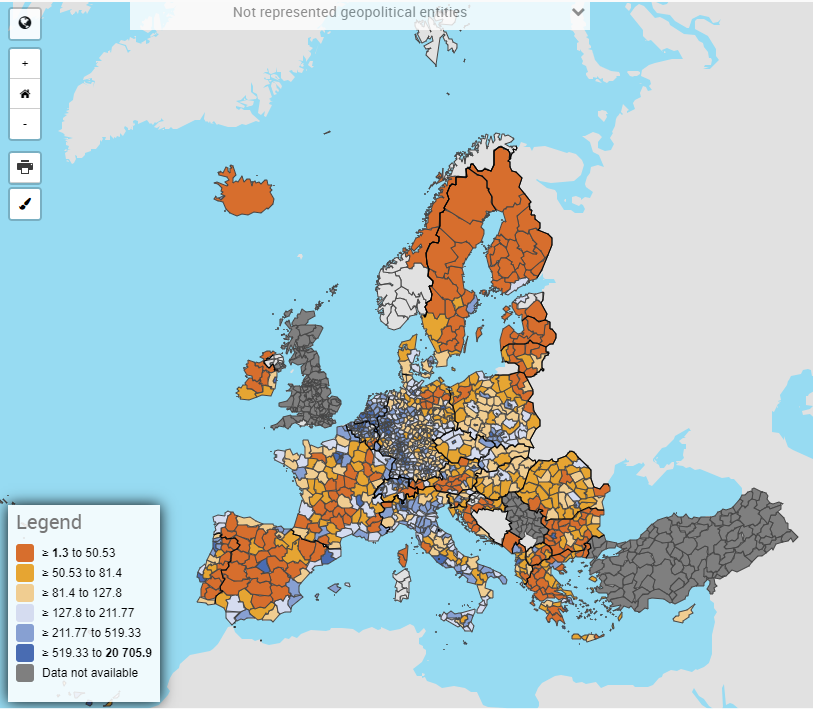
Member States send to Eurostat data on population on of 31 December of the reference year under Regulation 1260/2013 on European demographic statistics. The data are conventionally published by Eurostat as population on 1 January of the following year (reference year + 1). The aim is to collect annual mandatory and voluntary demographic data from the national statistical institutes. Mandatory data are those defined by the legislation listed under ‘6.1. Institutional mandate — legal acts and other agreements’. The completeness of the demographic data collected on a voluntary basis depends on the availability and completeness of information provided by the national statistical institutes. For more information on mandatory/voluntary data collection, see 6.1. Institutional mandate — legal acts and other agreements. The following statistics are available. Population on 1 January by sex and by: - single age and educational attainment / marital status / broad group of citizenship / broad group of country of birth; - five-year age group and citizenship / country of birth; - citizenship and broad group of country of birth / country of birth and broad group of citizenship; - broad age group and NUTS 3 (under regional data population folder); - single age and NUTS 2 (under regional data population folder); - five-year age group and NUTS 2 / NUTS 3 (under regional data population folder). Population structure statistics: median age of population, proportion of population by various age groups, old age dependency ratio.
-
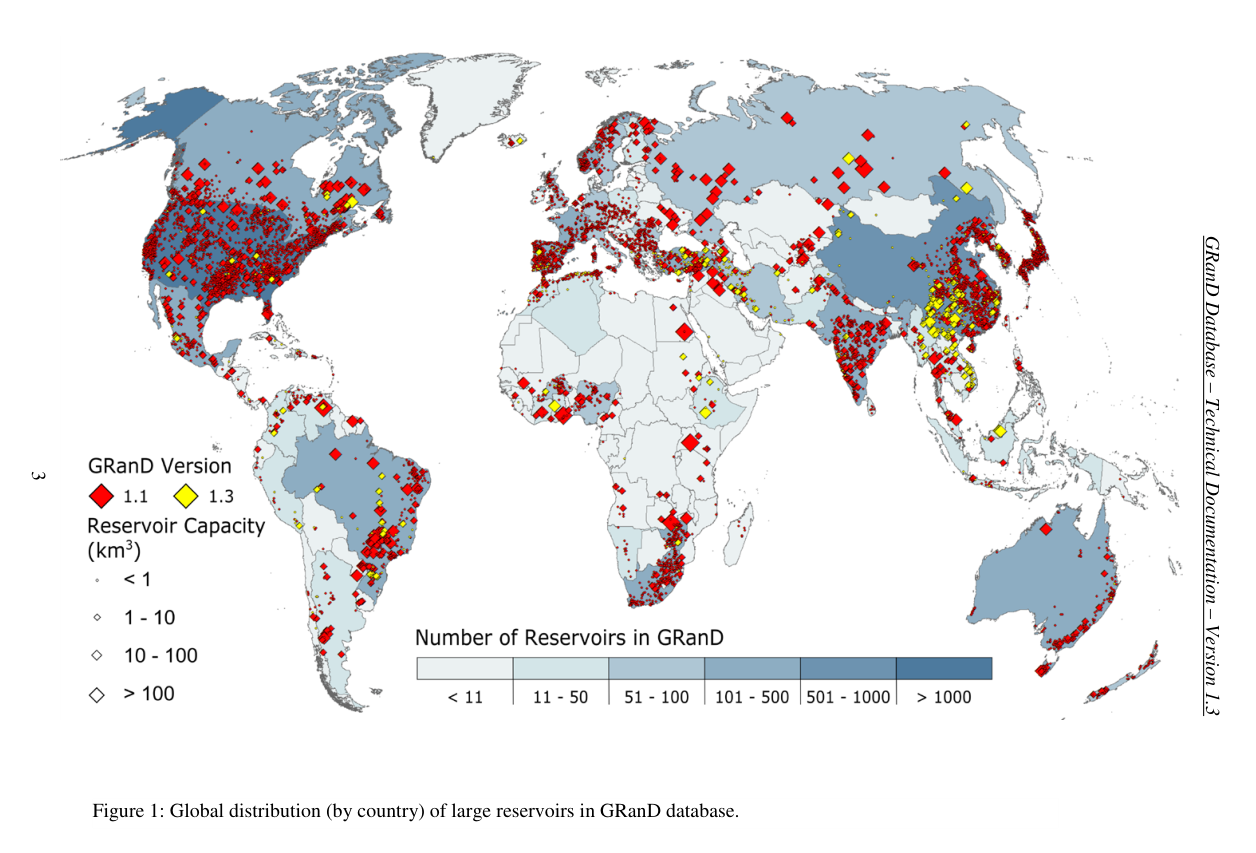
The Global Reservoir and Dam Database (GRanD) v1.1 is a product of the Global Water System Project, which initiated a collaborative international effort to collate existing dam and reservoir datasets with the aim of providing a single, geographically explicit and reliable database for the scientific community. The initial version 1.1 of GRanD contains 6,862 records of reservoirs and their associated dams with a cumulative storage capacity of 6,197 km3. Data was assembled from numerous sources by eleven participating institutions, and the dataset is managed by McGill University. Though GRanD has undergone an update, GRanD v1.1 will remain available to support existing and future research. GRanD v1.3 augments v1.1 with an additional 458 reservoirs and associated dams to bring the total number of records to 7320. Most of the added reservoirs were constructed between 2000 and 2016; global reservoir storage is increased by 666.5 km3. Updates have also been made to attribute data originally developed for GRanD v1.1; this includes a new column to indicate whether and when a dam has been removed. Access the data from our directory page.
-
Yearly data on freshwater resources, water abstraction and use are collected annually by means of the RWQ Eurostat Regional Water Questionnaire. Data aggregation: RBD (River basin districts according to the Water Framework Directive, 2000/60/EC) and their subunits. The classifications are made according to the definitions of the RWQ (Regional Water Questionnaire). NACE Eurostat strives for further harmonisation with reporting frameworks under current/future European legislation, such as the Urban Wastewater treatment Directive (91/271/EEC) or the Water Framework Directive (2000/60/EC). Collection and compilation of annual data on a diversity of topics, comprising the following data sets for every RBD/SU: Renewable fresh water resources; Annual fresh water abstraction by source and by sector and other sources of water (marine and brackish water, desalinated water, reused water); Regional water transfers; Water losses; Water use;
-
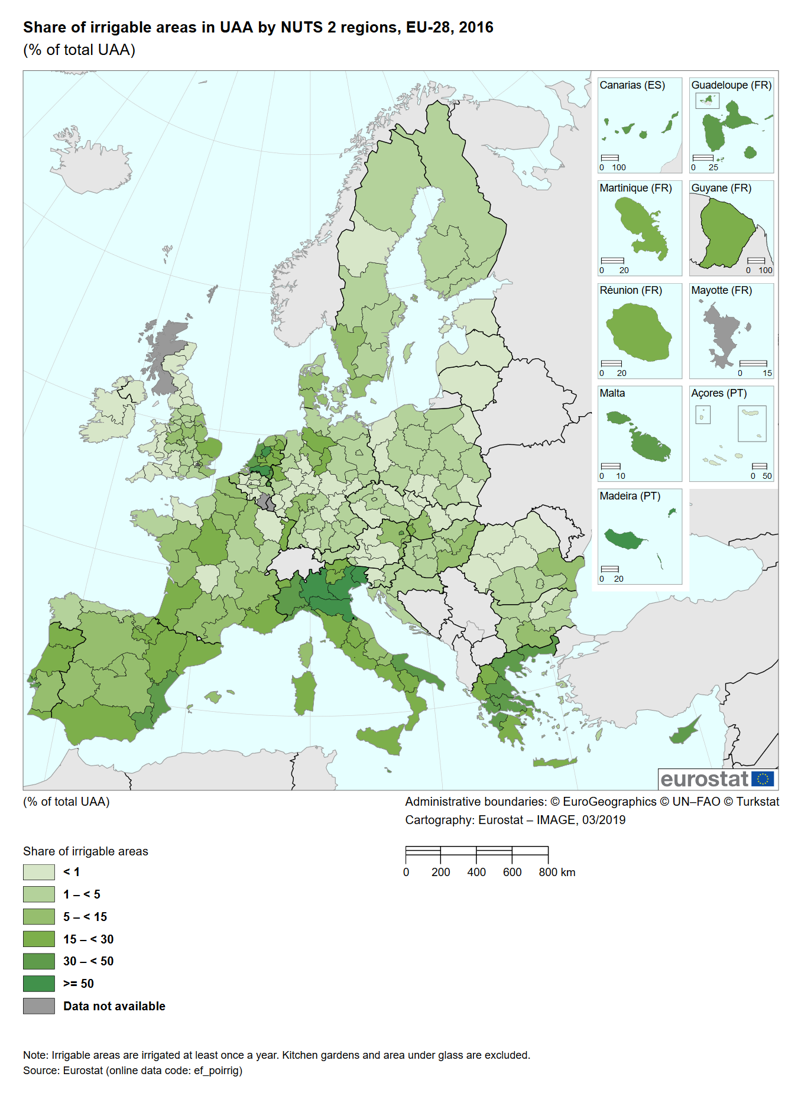
The indicator assesses the trend of the irrigable and irrigated areas and their share of the total utilised agricultural area (UAA). The irrigable area is the area which is equipped for irrigation. This area does not show so much variation from year to year as it is costly for the farmer to invest in irrigation equipment. The irrigated area measures the actual amount of land irrigated and can vary significantly from year to year due to, for instance, meteorological conditions or the choice of crop.